App-Native vs. Agentix-Native Architectures for On-Device AI Agents
Abstract
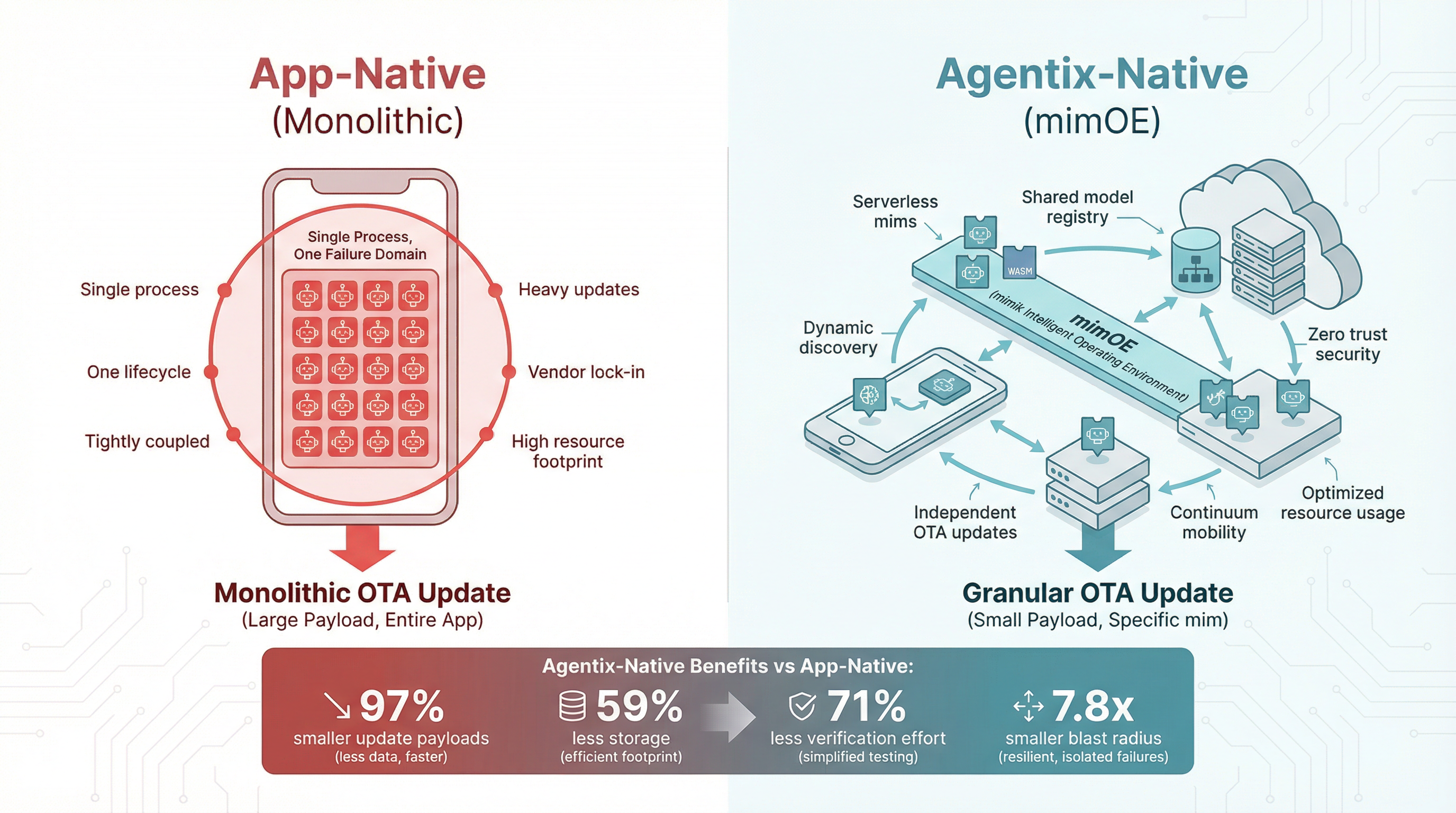
As on-device AI agents proliferate across domains such as health monitoring, industrial IoT, smart infrastructure, and personal assistants, developers face a key architectural choice: build agents within application-native service frameworks or deploy them as independently managed microservice agents in a dedicated operating environment. We term these paradigms app-native and Agentix-native. In the app-native approach, agents are implemented within a single application using platform IPC mechanisms (for example, Android Bound Services, iOS XPC, and Linux D-Bus), which effectively produce monolithic systems with tightly coupled deployment and failure domains. In contrast, the Agentix-native model packages each agent as a micro intelligence module (mim), a serverless microservice running on a lightweight operating environment (mimOE) that provides lifecycle management, service discovery, and coordination across the device–cloud continuum.
This paper presents a systematic engineering comparison of the two paradigms within the Device-First Continuum AI (DFC-AI) framework. Using analytical models derived from published benchmarks, we evaluate trade-offs across dimensions including evolvability, composability, inter-agent reasoning, regulatory modularity, continuum mobility, operational overhead, and system resilience. Our analysis highlights the architectural implications of serverless microservice agents, including dynamic composition, independent lifecycles, and shared model registries with caching and deduplication. While monolithic app-native systems may offer modest raw efficiency advantages, the Agentix-native architecture provides stronger modularity, resilience, and deployment flexibility. More fundamentally, because real-world agents must communicate beyond a single application process, a dedicated agent operating environment emerges not simply as an optimization but as a prerequisite for scalable multi-agent systems.